For most of human history, education moved slowly. Knowledge was passed from expert to learner in predictable ways—apprenticeships and repetition.
The world outside the classroom transformed at lightning speed, yet the learning process itself stayed remarkably traditional.
That gap between how we learn and how we live is no longer sustainable. Technology has reshaped communication, collaboration, and the workplace itself. Training must now evolve just as dramatically to keep pace. And the most exciting transformations in learning aren’t just about content—they’re about experience.
Why Training Needs More Than Information
People don’t struggle to find information anymore. In fact, they’re overwhelmed by it. The challenge isn’t access; it’s transformation.
True learning happens not when we consume information (which you’ll ironically forget in a couple of hours or days), but when we practice, internalize, and feel it.
Traditional training often falls short because:
- It’s passive – Listening doesn’t equal learning.
- It’s disconnected – Real-world application comes later—sometimes never. How many of us finished college and, instead of feeling excited, felt fear? Did we really know how to do anything? And when we finally entered the workplace, we felt so lost because those lectures weren’t enough. Knowing the theory was completely different from applying it in practice.
- It’s predictable – But real situations rarely follow a script, and you need way more than stationary knowledge to face them. I speak for myself. My first job was with autistic children, and unsurprisingly, they didn’t behave as in the textbook.
To thrive in modern environments, learners need dynamic skills—communication, adaptability, emotional awareness, and decision-making under pressure. These are not skills learned by reading. They’re skills learned by doing.
The Era of Experiential Learning
With new technology, we now have the ability to place learners inside situations that were once impossible, impractical, or too costly to recreate. This is where modern training is truly evolving.
Immersive tools—like VR—are a turning point because they elevate training from telling to experiencing. Instead of imagining a scenario, learners step into it. Role-playing with a colleague who already knows the script? No, they would rather face unexpected reactions. Instead of mentally rehearsing, they practice in environments that feel real.
Training becomes active, emotional, and memorable. Skills become embodied, not theoretical.
Why Immersion Matters
Research has shown for decades that people learn best through experience, even little kids, but until recently, this was limited to fieldwork, internships, or high-cost simulations. Today’s immersive technologies make those environments broadly accessible.
Now, we have VR and its immersive training that offers:
- Higher engagement: The mind pays attention when the stakes feel real.
- Safe practice: Learners can make mistakes without consequences.
- Repeatability: Scenarios can be revisited until the skill is mastered.
- Adaptability: Training evolves with the learner’s progress.
This isn’t simply a “tech upgrade.” It’s a structural shift in how humans can acquire skills.
Education Must Catch Up With the World It Teaches About
We live in a world where people collaborate across continents, present to global audiences, and adapt to constantly changing challenges. Yet traditional training still centers on abstract theory.
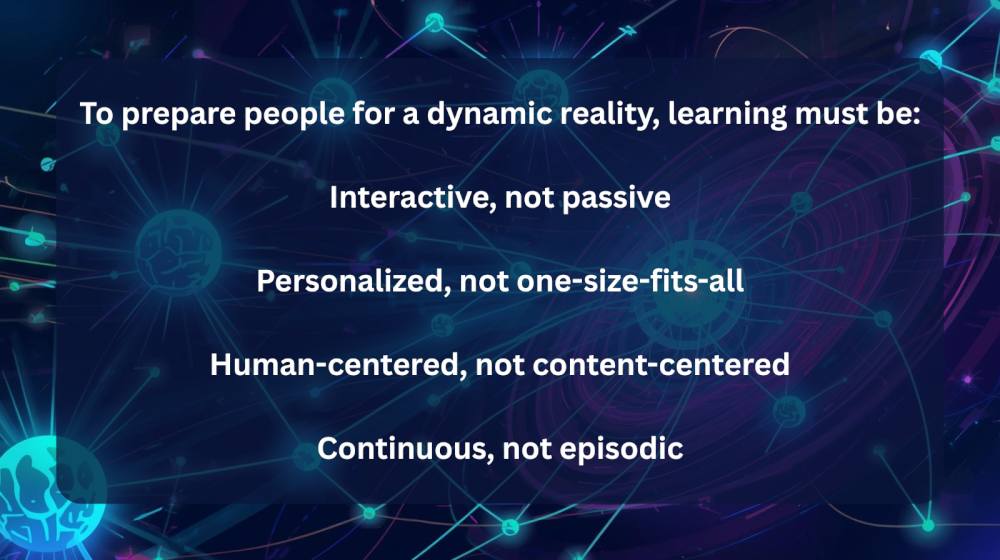
Modern learners expect experiences, not lectures. They expect environments where they can test, refine, and iterate on their abilities—just as they do with the digital tools they use every day.
A New Age of Learners, A New Age of Training
As technology continues to evolve, the learning process must evolve with it. We now have the tools to train not just the mind, but the whole person—their emotions, reactions, confidence, and behavior.
The future of training lies in experiences that are immersive, scalable, and deeply human. When learners can step into situations that mirror real life, they build skills that truly prepare them for real life.
Education may have been slow to change, but the path forward is clear: learning must be as dynamic as the world around us.

Cátia is a psychologist who is passionate about helping children develop and train social skills.